
English → Japanese
Learn Japanese through English: kana, meaning and everyday use
Build a route from readable kana and a first useful exchange to travel, work or JLPT study.
Start with Japanese you can hear and identify
Choose one beginner exchange with audio: greeting someone, introducing yourself or saying you did not understand. Listen, locate the matching Japanese text and check its English meaning before adding it to a study plan. You do not need prior knowledge of Chinese characters.
The Japan Foundation’s Irodori Starter provides English-supported lessons and audio organized around daily tasks. Its first lessons also introduce hiragana and katakana. Use the external lesson for teaching and context, and FreeLingo to organize selected vocabulary and review it.
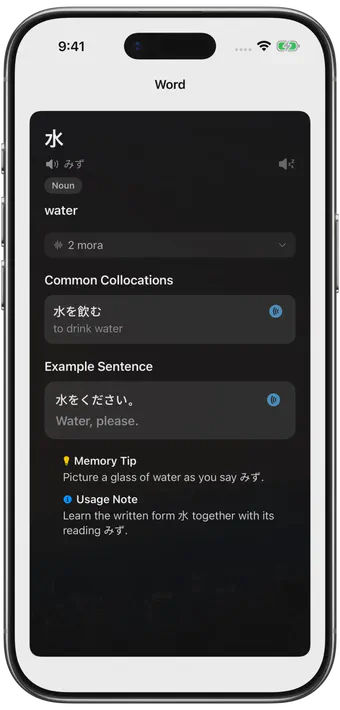
Read kana before depending on romanization
A practical first set is a few hiragana you meet in your lesson, followed by the katakana in a name or item you actually need. Inspect our hiragana and katakana material descriptions, then pair the written forms with reliable audio.
Do not assume an English-looking katakana loanword will sound or mean exactly the same thing as its English counterpart. Record what the Japanese item means in this situation. For length and timing, use long and short vowel material with a source recording; an English respelling is only a temporary aid.
With kanji, learn the reading of a word in context. The kanji reading source is a material to inspect, not a promise that every reading or proficiency level is covered.
Practice recovering when you do not understand
Irodori’s second lesson teaches すみません、よくわかりません as a way to signal that you do not really understand. Learn the complete expression with its audio and situation, rather than treating every part as a standalone English equivalent. Japan Foundation, Starter Lesson 2.
Try this sequence: listen to the other person’s line, decide whether you understood, use the clarification expression, then check what information you still need. Recognizing a phrase on a card and responding in a conversation are separate tasks.
Choose your next route
- Travel: prepare questions and the replies you may hear in Japanese for travel.
- Work: identify who is making a request, what action is needed and how to confirm it in Japanese for work.
- An exam: use the official task formats and a balanced practice routine in JLPT N5 preparation.
Suggested AI input: “Explain this Japanese exchange in English. Identify the speaker, the requested action and the level of politeness. Explain the unfamiliar word in this sentence, then ask me one comprehension question.” This is a prompt suggestion, not a verified App answer. Check readings and explanations against your course or dictionary.
Use FreeLingo alongside the original lesson
Set Japanese as the target and English as the base language. Check the current catalog or import your own permitted notes. Our resource pages describe source material; they do not confirm that the same book is currently selectable with English explanations. Inspect the first cards and audio after creation; import preview alone does not verify generated meanings.
Use eligible vocabulary in available Fun Tests for additional meaning practice, then return to the dialogue to listen and respond. Finish and save due reviews from their own task entry. Check App limits and membership conditions before planning a larger workload.
FAQ
Japanese learning questions
Do I need to know Chinese characters before learning Japanese?
No. Begin with kana and a short audio exchange. When you meet kanji, learn the reading and meaning of the word in that sentence instead of assuming the character already tells you how to pronounce it.
Can romanization replace kana?
Use romanization as a temporary aid, then return to the written Japanese and source audio. It can hide distinctions in timing and encourage English pronunciation habits. Keep kana with each beginner item.
How do travel and workplace study differ?
Does an N5 word list cover the whole exam?
No. Use official examples to identify the question formats and combine vocabulary with grammar, reading and listening. The N5 route explains how to turn errors into a focused review set.
Can I use the listed materials with English explanations?
Check the current App catalog with Japanese as target and English as base. These pages describe inspected source material, not verified English-base listings. You can also import your own permitted notes and check the first generated cards.
Are the voices AI-generated or recorded by people?
FreeLingo uses high-quality AI voices and also retains human-recorded audio resources. The source varies by language, entry and activity; check the current entry. Listen, repeat and use listening review where available. Playback does not provide automatic pronunciation correction or a pronunciation score. See audio sources and listening.
Start today
Turn today’s study material into tomorrow’s review.
Start with a few checked items, then build a learning and review routine that fits your task.
 Scan to choose your App Store region